Trusted Asset Data Source E-Book
Building Accurate, Auto-Updated IT Asset Trusted Data Source
Why Asset Data Must Be Auto-Updated
Almost all important IT decisions rely on asset and configuration data. However, many enterprises do not fully trust their asset ledgers and CMDB. Equipment is entered into the system when purchased or deployed, after which data gradually falls behind the field: memory replacements are not updated in records, firmware is upgraded through vendor tools, servers are moved to other racks, and decommissioned equipment remains in the asset list. Therefore, a truly trusted asset data source must have automatic update capabilities.
Why Traditional Asset & CMDB Maintenance Often Fails
- Data only collected at key points, not continuously updated,Asset records stay at device level, lacking component details,Multiple systems separately maintain different versions of "truth",Updated to latest state but lost change history
What Capabilities Does Auto-Updated Trusted Asset Data Source Need
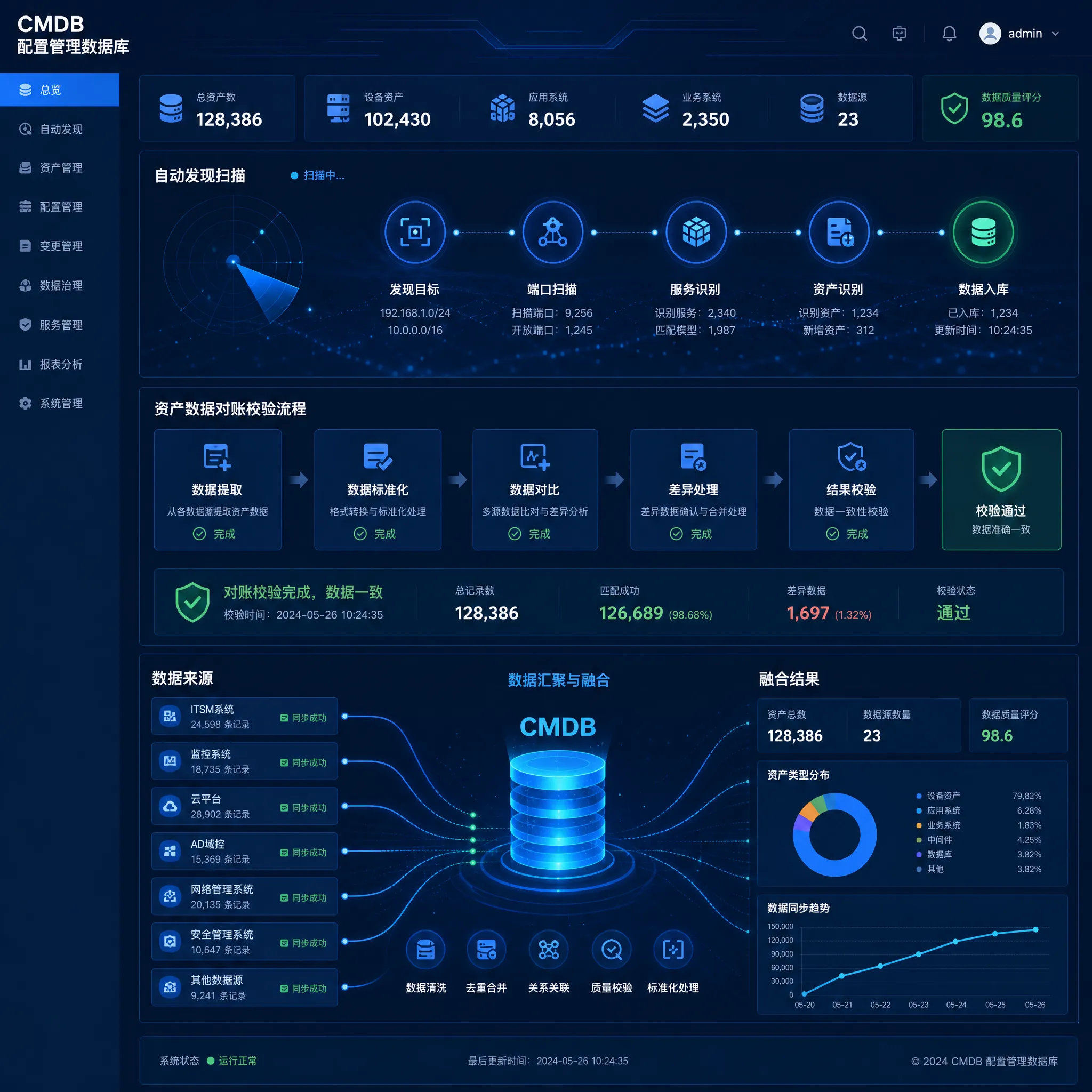
- Continuous, cross-layer auto-discovery: covering physical and logical layers,Data standardization and resource identity: cross-vendor data transformation and identity matching,Identify operationally significant changes: distinguish real changes from noise,Reconciliation-based updates: automatic or manual processing based on confidence and strategy
Implementation Path for Auto-Update Asset System
Enterprises do not need to redesign all asset and service management processes at once to gradually establish an auto-updating data foundation. They can start from one data center, one type of equipment or infrastructure supporting a key business, clarify evidence requirements and decision rights at each lifecycle transition point, and then gradually achieve auto-discovery, data reconciliation, process and report automation.
How CloudSino Builds Reliable Asset & Configuration Foundation
CloudSino connects physical asset facts, configuration management and processes, as well as business service relationships through DCOS, iDCOS and SmartBSM. DCOS observes the real physical environment. iDCOS manages configuration items and operations processes. SmartBSM understands business impact through accurate relationships.